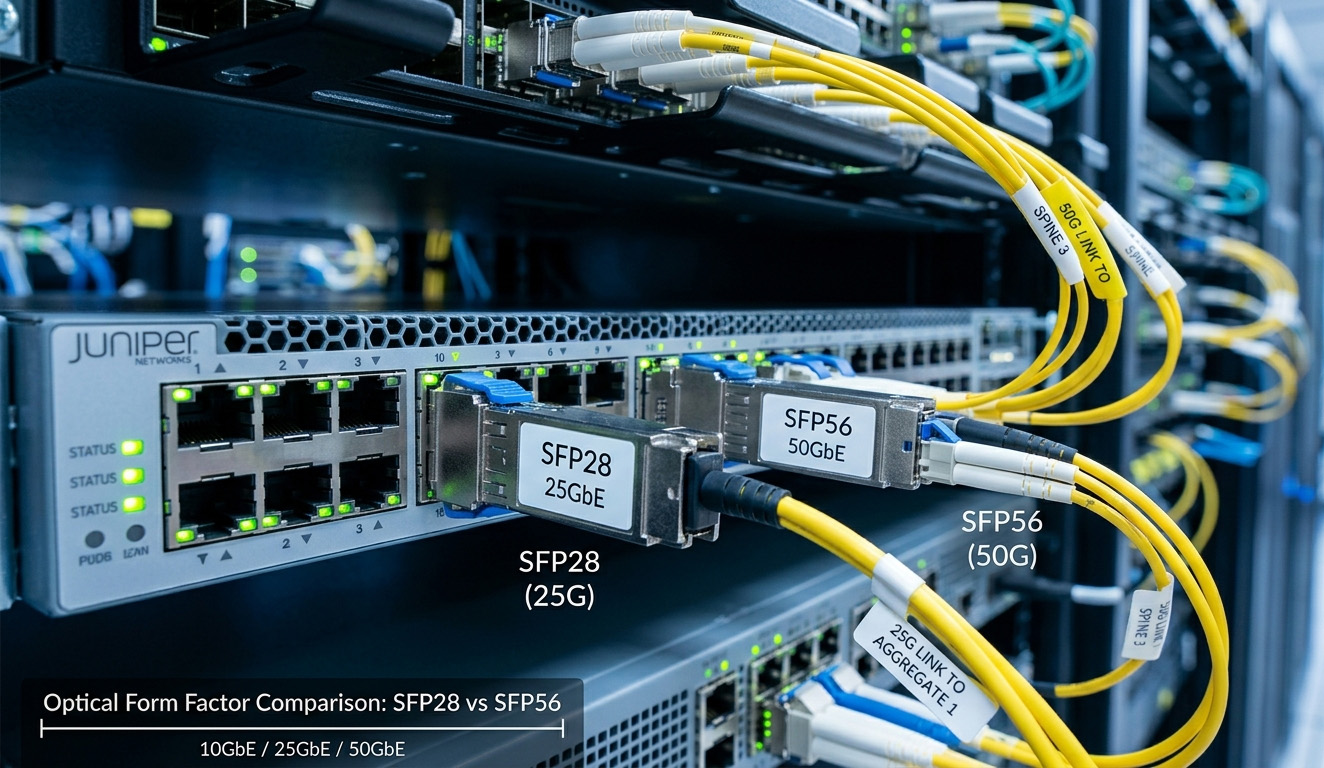
Beyond the Bandwidth: Mastering the Evolution from SFP to QSFP28 for Next-Gen Networks
In the current landscape of AI-driven data centers and 5G telecommunications, the demand for higher throughput has transformed optical networking from a supporting infrastructure into a strategic asset. Moving from 1G to 100G isn't just about speed; it’s about optimizing port density, power efficiency, and thermal management.
Understanding the technical nuances between SFP, SFP+, SFP28, QSFP+, and QSFP28 is essential for any network architect. As a pioneer in high-performance interconnects, INGKE TECHNOLOGY provides the critical hardware that bridges the gap between legacy reliability and future-proof performance.
1. The 1x Lane Evolution: SFP, SFP+, and SFP28
The Small Form-factor Pluggable (SFP) family defines the "entry-level" to "mid-tier" high-speed access. While they share a nearly identical footprint, their internal capabilities are generations apart.
SFP (1G): The foundation of Gigabit Ethernet. It remains a staple for enterprise access layers and industrial automation.
SFP+ (10G): The workhorse of the last decade. By removing the Clock and Data Recovery (CDR) from the module and placing it on the host PCB, SFP+ achieved a smaller, lower-power profile than its predecessor, XFP.
SFP28 (25G): The modern standard for server-to-switch connectivity. SFP28 provides 2.5x the bandwidth of 10G with superior incremental power consumption, making it the most cost-effective path to 100G (4x25G) architectures.
2. The 4x Lane Revolution: QSFP+ and QSFP28
The "Q" stands for Quad—four independent channels working in parallel to shatter the limits of single-lane transmission.
QSFP+ (40G): By bundling four 10Gbps lanes, QSFP+ enabled the first wave of high-density 40G aggregation. It remains vital for legacy core upgrades.
QSFP28 (100G): The current "Gold Standard" for data center spines. Each of its four lanes operates at 25Gbps. Its compact design allows for up to 36 ports on a single 1U switch face, enabling a staggering 3.6Tbps of total throughput.
A common industry challenge is the "Compatibility Paradox." Can an SFP28 module function in an SFP+ slot? While physically possible, the success depends on the Host-FEC (Forward Error Correction) and the module's internal coding.
This is where INGKE TECHNOLOGY excels. Our modules are engineered with:
Advanced EEPROM Customization: Ensuring 100% "Plug-and-Play" compatibility with major vendors like Cisco, Arista, and Juniper.
Optimized Thermal Dissipation: Using high-grade heat-sink materials to ensure stable performance in high-density, 24/7 operating environments.
4. Why INGKE TECHNOLOGY is Your Strategic Partner
Choosing a transceiver provider is about more than just a datasheet; it's about supply chain resilience and technical integrity.
INGKE TECHNOLOGY offers:
Comprehensive Portfolio: From 1.25G legacy SFP to cutting-edge 100G/400G QSFP-DD solutions.
Verified Reliability: Every unit undergoes rigorous BER (Bit Error Rate) and real-machine stress testing before leaving our facility.
Accelerated Deployment: With a robust global supply chain, we reduce lead times, helping you bring your network online faster.
Conclusion
The transition from SFP to QSFP28 represents a significant leap in networking efficiency. By partnering with INGKE TECHNOLOGY, you are not just buying hardware; you are investing in a verified, high-performance link that secures your data's journey across the digital frontier.