HomeResources
Optical Module Speed vs. Distance | Prof…
Optical Module Speed vs. Distance | Professional Design Guide
The Balance of Speed and Distance: Core Considerations in Optical Module Design
In the rapidly evolving landscape of optical communications, Data Rate and Transmission Distance are the two primary metrics defining network performance. For system architects, understanding the physical interplay between these two factors is essential for building scalable and reliable fiber-optic infrastructures.
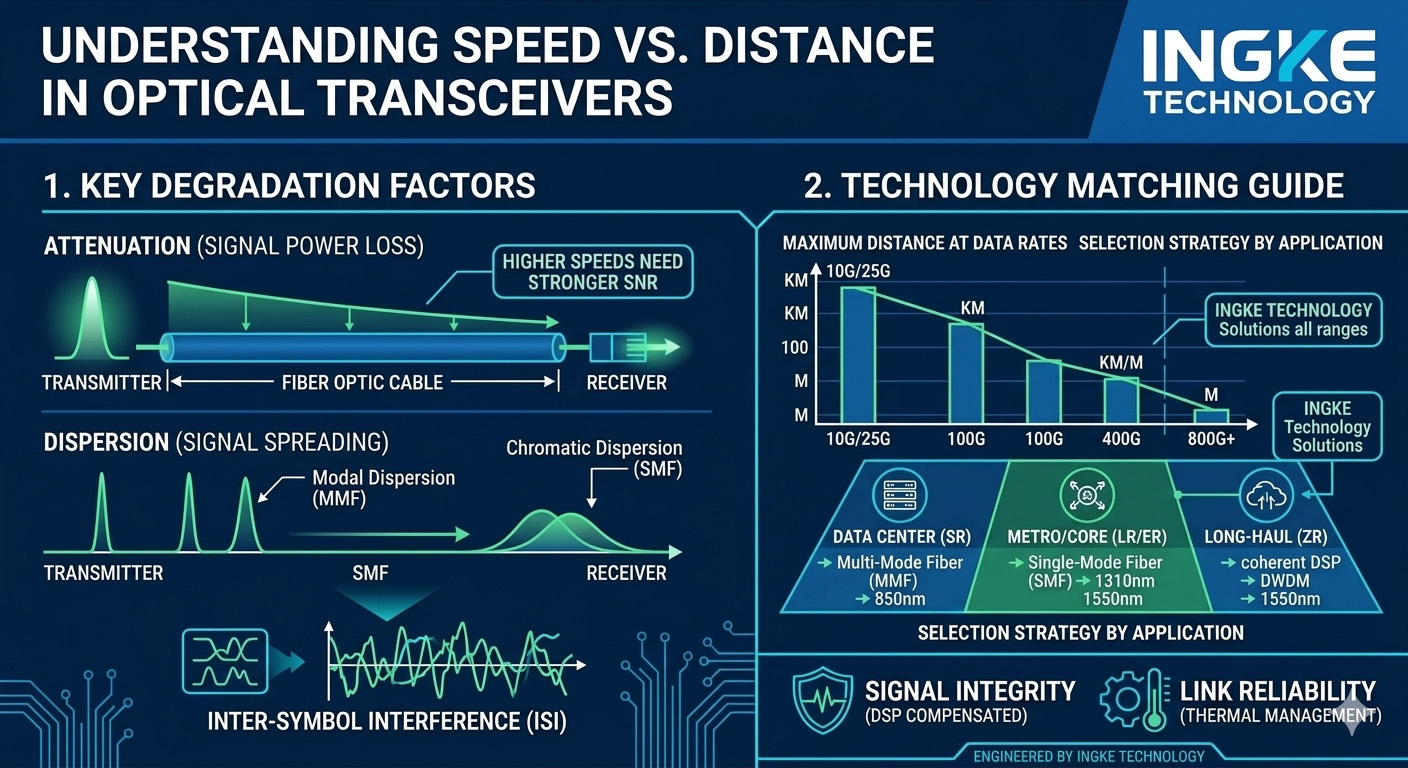
In fiber optics, speed and distance are often inversely related. As bit rates increase, the optical signal becomes significantly more susceptible to physical degradations:
Attenuation: The gradual loss of light intensity as it travels through glass. Higher data rates require a higher Signal-to-Noise Ratio (SNR), meaning the receiver has less tolerance for power loss over long spans.
Dispersion:
Modal Dispersion: Primarily affects Multi-Mode Fiber (MMF), limiting high-speed links (like 100G) to short distances.
Chromatic Dispersion: Causes light pulses to spread over time as they travel. In long-haul transmissions (>10km), this leads to Inter-Symbol Interference (ISI) and increased bit error rates.
2. Standard Solutions and Application Scenarios
Based on IEEE 802.3 standards, different combinations of speed and distance require specific optical technologies:
Data Rate
Protocol
Typical Distance
Fiber Type
Core Challenge
25G/50G
SR / LR
100m / 10km
MMF / SMF
Balancing power consumption with cost
100G
SR4 / PSM4
100m / 500m
MMF / SMF
Managing multi-lane alignment and crosstalk
400G
LR4 / ER4
10km / 40km
SMF
High SNR requirements for PAM4 modulation
800G+
DR8 / FR8
500m - 2km
SMF
Silicon photonics and ultra-high-density packaging
3. Engineering Excellence in High-Speed Transmission
To push past these physical boundaries, INGKE TECHNOLOGY utilizes advanced Digital Signal Processing (DSP) and high-precision TOSA/ROSA components. These technologies compensate for dispersion and non-linear effects, allowing for higher throughput without sacrificing link distance.
To ensure maximum reliability in the field, engineers should prioritize:
Link Budgeting: Always account for connector insertion loss and splicing points; a 3dB margin is standard practice.
Thermal Management: High-speed modules generate significant heat. Utilizing housings with superior thermal conductivity prevents frequency drift and component aging.
Signal Integrity: Using modules with integrated Digital Diagnostic Monitoring (DDM) allows for real-time tracking of laser health and power levels.
4. Conclusion
Selecting the right optical module is a strategic trade-off between cost, bandwidth, and reach. By leveraging the comprehensive connectivity solutions from INGKE TECHNOLOGY, network operators can deploy robust infrastructures optimized for both current demands and future-ready performance.