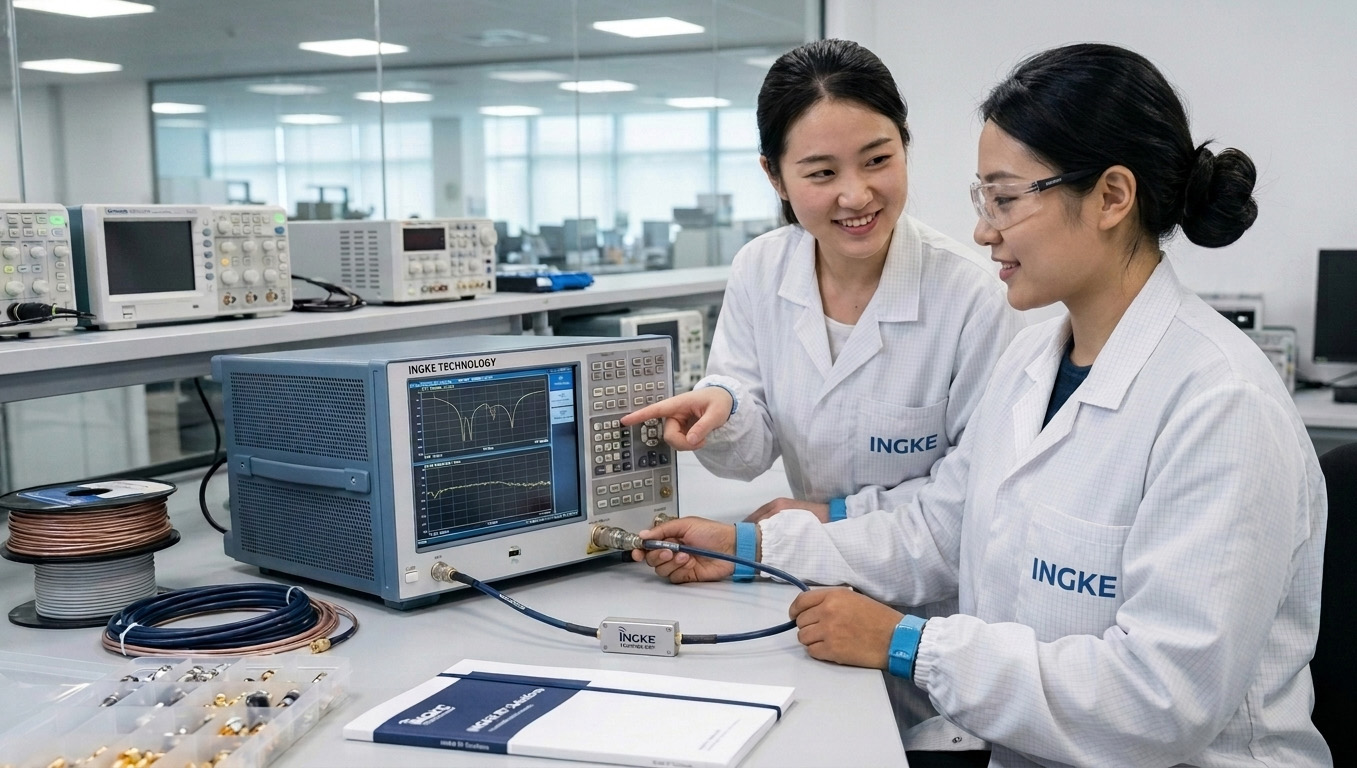
RF Cable Assemblies: The Infrastructure of High-Frequency Systems
RF (Radio Frequency) cable assemblies serve as the critical "nervous system" for microwave and wireless communication systems. Their performance directly dictates the signal integrity, range, and reliability of the entire device.
I. Key Performance Indicators (KPIs)
To evaluate an RF assembly, engineers focus on these primary metrics:
Characteristic Impedance: Standardized at 50Ω for data/radar or 75Ω for video. Any mismatch triggers signal reflections.
Insertion Loss: The power lost along the line. Lower loss ensures higher system efficiency and better sensitivity.
VSWR (Voltage Standing Wave Ratio): A measure of impedance matching. A ratio closer to 1.0 indicates minimal reflected power.
Phase Stability: Crucial for phased-array antennas, measuring how much the signal phase shifts during bending or temperature swings.
Shielding Effectiveness: Expressed in dB, it defines the assembly’s ability to contain signals and block external interference (EMI).
II. Material Construction
A typical coaxial assembly consists of four functional layers:
Inner Conductor: Usually silver-plated copper (SPC) for high conductivity or copper-clad steel (CCS) for strength.
Dielectric: Often PTFE (Teflon) or expanded PTFE. This layer determines the Velocity of Propagation (VoP).
Outer Conductor/Shield: A combination of foil and braid that acts as the return path and EMI shield.
Jacket: Materials like FEP, PVC, or LSZH provide environmental protection and mechanical durability.
Key Point: For millimeter-wave applications (above 26GHz), Low-Loss Phase-Stable cables are mandatory to maintain timing accuracy.
III. Selection Criteria
When choosing an assembly, consider these operational constraints:
Frequency Range: Ensure the connectors (SMA, N-type, 2.92mm, etc.) and cable are rated for your highest operating frequency.
Power Handling: High-power transmitters require larger diameters to dissipate heat and prevent voltage breakdown.
Mechanical Flexibility: Use Semi-Rigid for fixed installations to maximize performance, or Flexible cables for applications requiring repeated movement.
Environmental Rating: Specify IP67/IP68 sealing for outdoor or marine environments to prevent moisture ingress.
IV. Common Failure Modes
Over-Bending: Exceeding the Minimum Bend Radius deforms the dielectric, causing permanent impedance spikes.
Torque Issues: Under-tightening causes high VSWR; over-tightening damages the connector interface.
Connector Stress: Lack of strain relief (heat shrink) leads to wire fatigue at the solder or crimp joint.