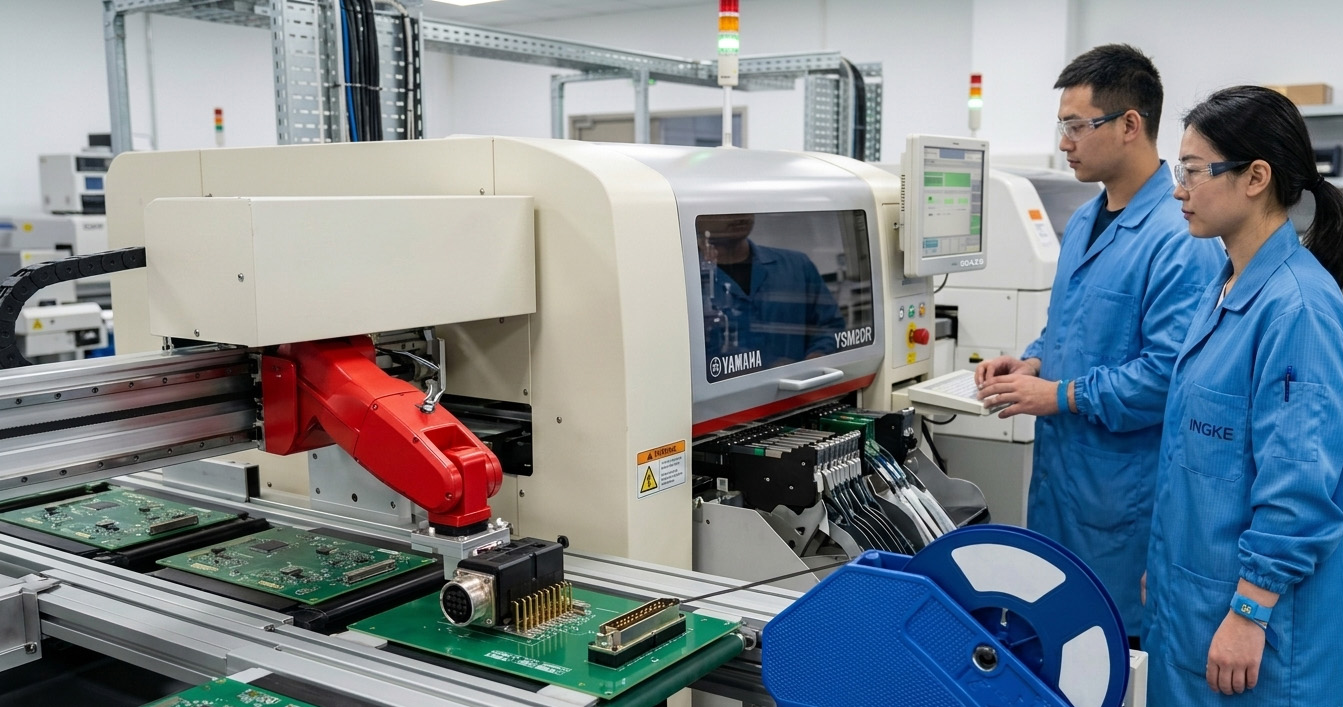
Automating M12/M8 Connector Assembly: SMD and THR Guide
M-Series Circular Connectors: Advancements in SMD and THR Automation Technologies
In the era of Industry 4.0, Printed Circuit Board (PCB) assembly has shifted heavily toward total automation. Traditional board-mount M-series connectors typically relied on manual soldering or wave soldering (THT), which created significant throughput bottlenecks on standard SMT lines. To achieve fully automated production while maintaining high mechanical resistance against frequent mating cycles, Surface Mount Device (SMD) and Through-Hole Reflow (THR) technologies have become the industry standard for modern M8 and M12 connector manufacturing.
1. Technical Paradigm: SMD vs. THR
When designing board-level M-series interfaces, engineers must balance mechanical retention, processing efficiency, and PCB routing density.
Technical Metrics
SMD (Surface Mount Device)
THR (Through-Hole Reflow)
Termination Style
Gull-wing or flat-surface pads
Pin-in-Paste (PIP), penetrating PCB vias
Mechanical Retention
Moderate. Relies solely on surface joint tension
Extremely High. Solid 3D anchor filling the barrel
SMT Line Compatibility
Native. Fits standard pick-and-place
Excellent. Requires specific tape & reel feed
PCB Real Estate Impact
Low. Keeps the reverse side free for routing
High. Occupies all layers, restricting routing tracks
Primary Application
Compact M5/M8 signal interfaces
M12/M23 power and high-stress lines
2. The THR Process Flow: "Through-Hole Strength via SMT Speed"
The THR process allows through-hole components to be placed and reflowed simultaneously with standard SMD components, eliminating the need for an independent wave-soldering stage.
Precision Paste Overprinting:
A customized SMT stencil applies solder paste over and directly into the plated through-holes (PTH). Squeegee parameters are optimized to ensure a target target hole-fill of 75% to 100% prior to component insertion.
Automated Pick & Place:
High-speed placement machines equip specialized vacuum nozzles to grasp the connector body. The long termination pins are driven straight through the paste-filled holes. The pin displaces the paste, coating both the pin and the inner barrel wall.
Convection Reflow:
The assembly enters a multi-zone reflow oven. The solder paste inside the barrel melts, and capillary action draws the liquid alloy uniformly through the via, creating a robust, double-sided solder fillet upon cooling.
3. Engineering Challenges in Connector Design for THR Automation
Passing a complete M-series connector housing through a 260°C lead-free reflow profile demands stringent raw material selection and specialized structural engineering:
High-Temperature Insulator Materials
Standard thermoplastics like Nylon 66 will distort or blister under reflow temperatures. THR connectors utilize premium high-performance polymers such as Liquid Crystal Polymers (LCP) or high-temperature polyamides (PA9T / PA4T). These compounds ensure zero dimensional deflection at continuous peak temperatures up to 260°C.
Pin Geometry and Lead Chamfering
Length Optimization: THR pins must not extend too far below the PCB bottom plane. An ideal protrusion of 0.3mm to 0.5mm avoids component deflection during placement and guarantees optimal bottom fillet formation.
Targeted Chamfering: Pin tips feature a distinct conical chamfer. This shape guides the pin cleanly into the via during high-speed automated placement, compensating for minor machine axes offsets.
Pick-and-Place Optimization
Tape & Reel Packaging: Connectors are delivered in broad embossed carrier tapes adhering to the EIA-481 standard, enabling seamless compatibility with automated tape feeders.
Removable Pick Pads: Because the mating face of a circular connector is inherently hollow, manufacturers integrate a temporary, heat-resistant plastic pick pad over the shell opening. This provides a flat surface for vacuum nozzle suction and is peeled off post-soldering.